Editorial Premise
Blue-green infrastructure can turn flood management into public space, habitat and daily mobility rather than isolated engineering.
Rather than treating a blue-green model for urban design as an inevitable trend, this article asks what evidence would make the claim useful. Bishan–Ang Mo Kio Park offers a bounded case through which to examine implementation, limits and the conditions required for meaningful transfer.
Evidence in Focus: Bishan–Ang Mo Kio Park
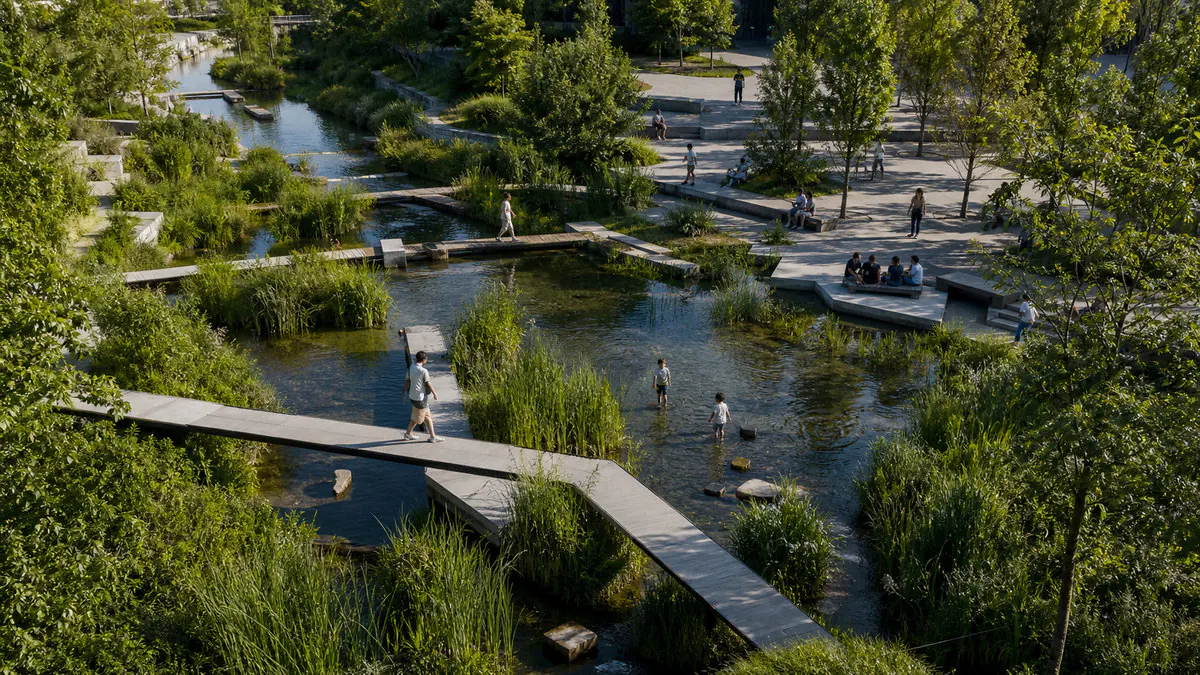
The naturalised river and park integrate drainage capacity, recreation and ecology within a dense urban district.
The naturalised river and park integrate drainage capacity, recreation and ecology within a dense urban district. Its significance lies in the connection between a stated ambition and an observable mechanism. The reference set—PUB Singapore — Kallang River at Bishan–Ang Mo Kio Park; C40 — Bishan–Ang Mo Kio Park and Kallang River; National Library Board Singapore — ABC Waters Programme; Henning Larsen — Bishan–Ang Mo Kio Park and Kallang River—is used to verify that mechanism and to locate gaps in the public account.
What the Evidence Cannot Prove
Transfer requires local hydrology, land governance, maintenance capability and community access—not visual imitation.
Transfer requires local hydrology, land governance, maintenance capability and community access—not visual imitation. The gap is not a footnote; it determines how confidently the case can inform investment, policy or professional practice.
Practice Agenda
Design at catchment scale, model extreme events, provide safe overflow, connect habitats, fund maintenance, and monitor public use.
Design at catchment scale, model extreme events, provide safe overflow, connect habitats, fund maintenance, and monitor public use. Teams can use this sequence to turn a broad ambition into named decisions, measurable conditions and a schedule for review.
AURELIS Position
Green city design is an operating relationship between water, land, people and stewardship.
Green city design is an operating relationship between water, land, people and stewardship. AURELIS treats that position as an invitation to further evidence, not as a final verdict on the project or the wider field.
Keywords
Blue-green Infrastructure / Flood Resilience / Singapore / Public Space